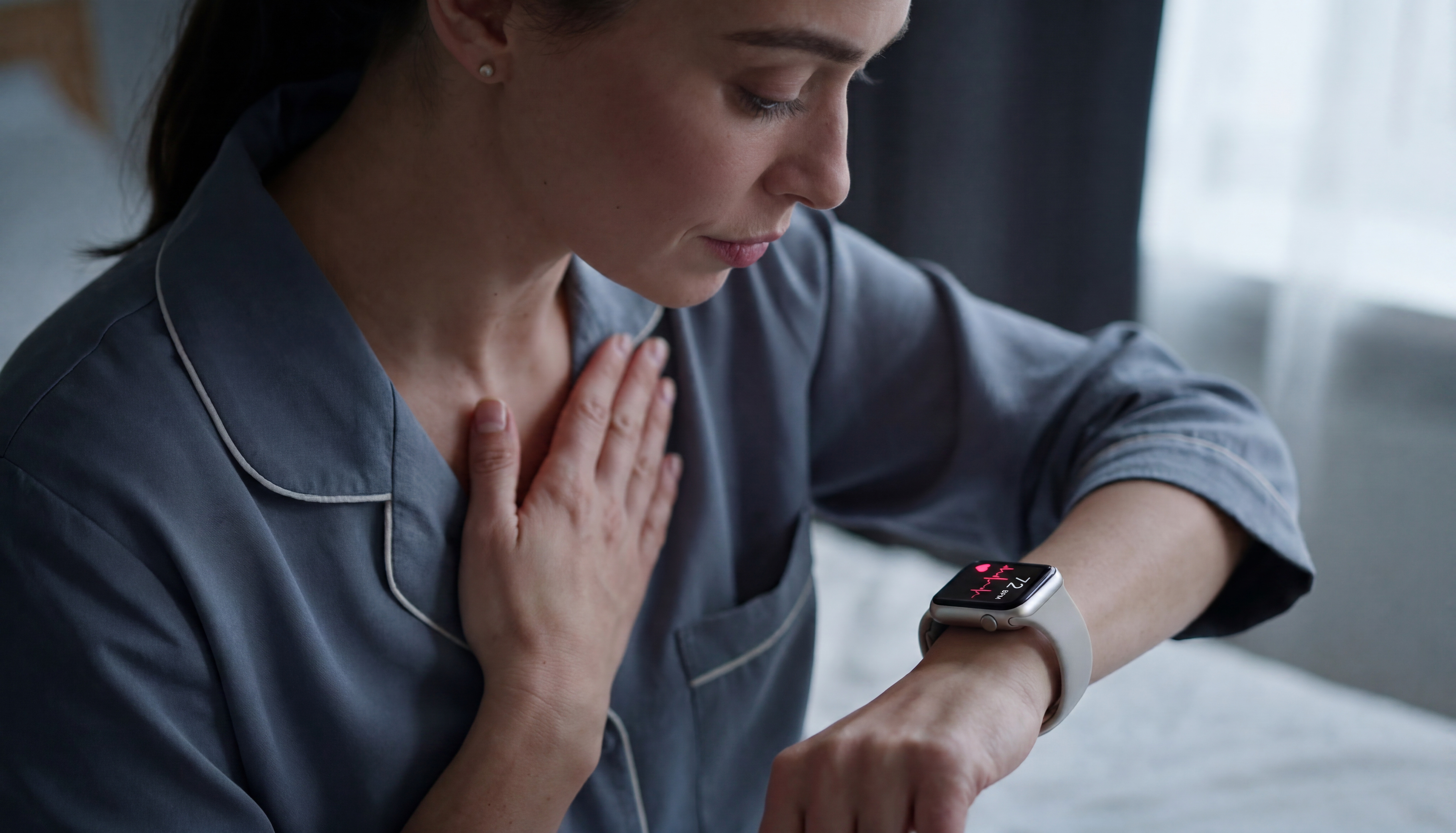

The science still belongs to the AHA. The morning doesn't.
We read the American Heart Association the way a newcomer would — from the outside — and one thing came clear before any number did. The institution still owns the science of the heart. It no longer reaches women where they read about their hearts now: the ring, the app, the lab result.
The shift is permanent. Personal control over one's own health has outlasted every campaign built around it. A woman tracks her sleep, her cycle, her blood pressure, and her blood sugar on devices she chose and pays for. The AHA's habits were set in an era when being the trusted source meant broadcasting findings outward. The audience has moved on.
We read the AHA's public face — its websites, flagship campaigns, annual reports, and the companies now competing for the same morning moment of a woman's attention. No private data. One question: what does the public picture say about the next ten years. We do not grade campaigns or count impressions; we read what the AHA talks about, what its competitors talk about, and the places where two important things are never said together. The decisions belong to the AHA. The next decade is already pulling in one direction, and the institution is the one positioned to answer it.
The 2050 forecast that six in ten women will have heart disease is driven by rising blood pressure and metabolic risk — the upstream territory that consumer-health companies have already claimed with language the AHA has not adopted.
Younger women's awareness fell twenty-one points in the decade to 2019, even as the Go Red for Women campaign (the AHA's flagship women's-heart effort) entered its second decade. The women it had already reached stayed loyal; the next generation never arrived — and they are the group the forecast says will be hit hardest.
The AHA's $6.1 billion research base keeps working even where the institution is absent: it is what makes a wearable's alert credible and a lab test meaningful. Today that credibility is doing its work for products the AHA did not build and earns nothing from.
The mandate, and its boundary
The AHA came to us with one question: as health care shifts toward prevention and personal control, how does it stay the source women trust? We answer it from the outside, reading only what any member of the public can see: the AHA's own websites and campaigns, its published financials, and the public presence of the organizations it now competes with for attention. No private operating data, no donor records, no campaign performance numbers. The scope is the public picture, and what that picture says about where the institution should move next.
Four shifts that make the timing urgent
The wellness market passed $480 billion in 2024, and prevention is its fastest-growing part. Healthy people now pay out of pocket to catch a problem early, in the quiet years before any symptom appears.
More than 600 million wearable devices shipped in 2025. The ring, the watch, and the lab-test app give a continuous read on a person's body that once required a doctor's visit. A woman learns the vocabulary of her own heart from products that never asked the AHA to confirm what they tell her.
Public trust in the US healthcare system dropped from roughly 71% in 2020 to around 40% in 2024, and a 2025 study found no institution is now widely trusted on health. Younger adults weigh a doctor's advice against a friend's, a creator's, and their own research. The expert-on-a-stage model that built the Go Red campaign no longer decides whom this audience believes.
Cardiovascular care costs the country more than $239 billion a year, much of it flowing through employer health plans and household budgets. Health has become a money decision. The diagnosis still comes from a clinic, but what it costs and which benefit covers it now get decided in the family budget and at open enrollment.
10 numbers that reveal AHA's reach, relevance and risk
What the conversation is built from — and where it has holes
Every topic the AHA talks about in public has a place in the picture below. Topics drawn close together are discussed in the same breath. Topics far apart are rarely talked about together.
Two subjects sit at the center of the AHA's public language: the institution itself and women's heart health. Many other topics connect back to those two themes. Around them sit distinct neighborhoods of language: prevention and personal care, research and advocacy, the shift from expert to lifelong guide, the cost of care, and clinical authority. The subjects are well defined. The challenge is the distance between them. The AHA's authority and a woman's daily experience occupy different neighborhoods, with very little language connecting the two.
The AHA's authority and women's daily lives have come apart.
The American Heart Association owns the science of the heart. It owns little of the territory where women now experience it: the wrist, the app, the lab result, the household budget. Trust has migrated from campaigns to interfaces.
— Shur Creative Partners
Five findings, and the future each one is building
Five findings describe where the institution's authority and women's daily lives have come apart. Each is small enough to dismiss on its own, and none arrives all at once. Followed forward, they converge on a single outcome: the AHA keeps the credit for the science while losing the relationship with the people it exists to serve. The fact comes first; the story is where it leads.
The science stops at the doctor's door
The AHA's greatest asset is its authority over the science: the research, guidelines, and standards that shape cardiovascular care. But that authority largely reaches the clinician, not the woman managing her health day to day. A 34-year-old tracking her blood pressure through an app and occasional primary-care visits is unlikely to encounter the institution behind the guidance. The science remains in the clinic; her relationship with health lives on her phone. The gap is widest among the younger women identified in the AHA's own 2050 forecast.
The relationship forms without connection to the AHA. The 34-year-old who has worn an Oura ring for most of her adult life will eventually have a real scare: a flutter that will not settle, a pregnancy that turns her blood pressure dangerous. In that moment the reference she reaches for is already chosen, the device on her finger and the app it feeds, because the habit was built over a thousand ordinary mornings the institution was not part of. By the time the scare arrives, the choice of who to trust has already been made, years earlier, on days when nothing was wrong.
The companies women check every morning carry no AHA mark
Oura's ring, the Apple Watch, Function Health's lab panel, and Whoop's band each measure something the AHA's research first established, and not one carries its name. These products reach a woman every day. The AHA's signature moment with women comes once a year, in February. The result is a steady stream of heart readings she trusts, delivered by brands that never had to fund the science behind them.
The science becomes a public good that others monetize. The AHA's $6.1 billion research base keeps working even after the institution loses its place in daily life. It makes a wearable's alert credible, lets a lab test claim it means something, gives a prevention app its scientific footing. The institution funds that science as a public good; the products convert it into paid daily contact with the woman, taking the membership, the loyalty, the morning ritual. The AHA creates and validates the science. Others capture the daily engagement. Over time, the institution's own research strengthens the products that mediate the relationship, making it harder for the AHA to maintain a direct connection with the people it serves.
The size of the gap is now measurable. The AHA spends $226 million a year producing the evidence that makes a heart reading mean something. Two device makers alone, Whoop at a roughly $1.1 billion annual run-rate and Oura's nearly five million paying members at close to $1 billion, already earn more than $2 billion a year selling products that evidence validates, more than the AHA's entire $1.3 billion of annual revenue. Of that daily-contact revenue, the institution captures none. A heart-health authority is underwriting a billion-dollar consumer-health business and keeping zero percent of it.
Heart disease is explained as a diagnosis, never as a household cost
The AHA speaks fluently about clinical risk and rarely about cost. Yet cardiovascular care costs more than $239 billion a year, with prevention decisions increasingly made through employer health plans and household budgets. The people making those decisions think in dollars, coverage, and value. The institution with the deepest evidence in the field does not yet speak that language.
The one money relationship left in view is the wrong one. Stay out of the conversation about what heart health costs a household, and the institution's most visible money relationship with women's health stays the one that works against it. The Heart-Check seal earns the AHA certification fees from food and beverage manufacturers, and among those who have paid to put it on their products are Coca-Cola and PepsiCo. A heart-health authority collecting fees from soda and processed-food makers sits directly on the two measures where the institution is already most exposed: trust, which carries the heaviest weight in the scorecard at 35 percent, and differentiation, where the institution scores 53 out of 100, third from the bottom of the nineteen-brand field and seventeen points under the field median. The money funds the work, and the same arrangement quietly drains the credibility the work depends on.
Left in place, the conflict compounds as the certification model extends. Every new seal placed on a product that women are told to eat less of widens the gap between what the institution funds and what it appears to endorse. The British Heart Foundation holds a trust score of 74 to the AHA's 63, and a differentiation score of 66 to its 53, off a smaller financial base — proof the deficit is structural, fixable by a peer running a leaner operation. A move to license verification onto a woman's own physiological readings, rather than onto a manufacturer's product, is the version of the model that resolves the drag instead of repeating it.
Admiration is not a relationship
The AHA helped build the science behind modern heart monitoring, yet much of its outreach still reflects a pre-wearable world. Heart health is no longer something women encounter only during a doctor's visit or an annual awareness campaign. It now arrives daily through watches, rings, apps, and lab dashboards.
Admiration without presence becomes irrelevance in slow motion. Trust that is never used in daily life thins. A woman can hold the institution in real regard and still never let it near the readings that govern her day. A decade of that and it arrives beloved and unconsulted: the logo still good for a nod of recognition, but no longer for a place in the moment she decides what to believe about her own heart. The erosion is quiet, each skipped morning adding a little, and it finishes before anyone marks the moment it began.
The youngest women, most at risk, have drifted the furthest
Awareness that heart disease is women's number-one killer fell fastest among the youngest women and women of color — the very groups the 2050 forecast says will be hit hardest. Go Red ran for two decades alongside that slide. It kept the women it already had, but the next generation never arrived.
The upstream story gets told by someone else. The slow upstream years, long before anything goes wrong, are the ground consumer-health companies have already claimed. Function Health sells the annual blood-test panel that catches the trend early. Levels, a blood-sugar-tracking app, built its message on blood sugar as the root of heart trouble. The prescribers of the new metabolic medicines speak fluently about staying ahead of the curve. All use the active daily verb the AHA rarely does: prevent. If the institution keeps describing heart disease as an emergency to be survived, the youngest, highest-risk women will learn the language of their own upstream years from a subscription, and credit the wisdom to whichever brand delivered it daily.
Taken together, the five trends point to a single outcome: the generation most likely to face heart disease is learning whom to trust from products and platforms the AHA did not build. By the time those loyalties are established, they are difficult to unwind.
Who the AHA competes with now
For a century the American Heart Association answered to other health charities. The contest is no longer decided there. When a woman wants to understand her heart on a given Tuesday, she glances at the ring on her finger, reads the lab results in an app, or asks a telehealth service. The AHA now competes for that daily moment against two groups at once: the peer nonprofits it has always measured itself against, among them the British Heart Foundation, the American Cancer Society, and the Alzheimer's Association; and the newer consumer-health companies selling wearables, lab-testing subscriptions, and apps, among them Function Health, Apple Health, Oura, Whoop, Levels, and Hims & Hers. The AHA funded the science that explains what these products measure. The products own the screen where people read the answer.
Nineteen organizations, one field of attention
This ranks health nonprofits and consumer-health companies side by side, by how strongly each holds women's heart-health attention today. It measures attention, not charitable impact: how strongly each organization holds a place in women's heart-health awareness today. SBPI is the Structural Brand Power Index, the five-measure score explained in the note below the table and in the appendix.
Function Health owns the lab subscription. Apple owns the wrist. Oura owns the woman's life stages. The American Heart Association ties for thirteenth — holding the science without yet holding a place in the daily lives where people read it.
Two different contests are stacked inside this one list. The nineteen organizations split cleanly into two groups: health nonprofits competing for the charitable dollar and the donor relationship, and consumer-health companies competing for a woman's daily attention through a ring, a watch, a lab panel, or an app. The two groups are scored on the same five measures, but they win on different ones. The product companies lead the field on differentiation by eighteen points at the midpoint (a typical product scores 79, a typical nonprofit 61) and on loyalty by fifteen (72 against 57). The nonprofits lead on mission clarity (70 against 62). On trust the two groups are level, both at 68. Which group a ranking flatters depends entirely on which measures it rewards.
Scored the way health causes are scored, with trust and mission carrying most of the weight, the AHA comes out a credible nonprofit: eighth of the twelve nonprofits in the field, mid-pack, composite 62.30.
Scored the way the consumer-health field is scored, rewarding a distinctive daily presence over institutional trust, the AHA falls to fifteenth, composite 59.40, last among the seven product companies.
The AHA wins the contest it was built for and holds its own among peer charities. It is mispriced for the contest it now also has to play, where a distinctive daily presence decides the score: its gap to the product companies is six points when trust is rewarded, and triples to fifteen the moment a woman's everyday attention becomes the test.
The whole deficit sits in one measure
The foundation is intact: four of the five scores sit in the low-to-mid sixties. Differentiation is the lone outlier at 53. It measures whether the institution owns a distinctive place in a woman's daily life, where the field's leaders score 65 to 70. That one measure drags the rank down, and it carries only 10% of the total, so it is also the most fixable.
Trust is real, and it is not yet attached to a distinctive daily presence. That is the gap to watch: a strong score sitting right next to the weak one, with nothing yet connecting them. The British Heart Foundation shows this gap can be closed. The UK's national heart charity ranks fifth at 70.50 on the same five measures, with higher trust, equal mission clarity, and a differentiation score of 66 against the AHA's 53, because it owns a distinctive everyday presence: roughly 700 charity shops on UK high streets and a close relationship with the National Health Service. People meet the brand in ordinary life, week in and week out, well beyond any awareness month. That settles the question a board member most needs answered. A national heart charity can hold strong trust, strong mission, and a distinctive daily presence at once. The AHA's gap is specific: that everyday presence has simply not been built yet, and a thing that has not been built can be built. The AHA has simply not shown up in daily life yet. The everyday ground is still open; no consumer device has taken it from a nonprofit that competed for it and lost.
Five moves, ordered by what moves the score most
Become a daily presence women use year-round
Move Go Red for Women from a February event toward a year-round companion a woman actually uses, earning a place in her ordinary Tuesday the way the ring on her finger already has one. Start with the content and tools women already search for between doctor visits, in the language of prevention and personal control. — Lifts: Differentiation, Loyalty
Charge for the cardiovascular authority every device already borrows
Every reading on the 611.5 million wearables shipped last year is only legible because of the science the AHA funded, and not one of those readings pays the AHA back. There are four ways to charge for that authority, and they climb in value. The weakest is a one-time endorsement seal on a device or a lab result, a flat badge like the Heart-Check mark the AHA already licenses to food brands in the grocery aisle. Above it sits a recurring data license, where the AHA's evidence becomes the verification standard built into the tools themselves, paid per product and scaling with the installed base. Higher still is the position that captures the most: the AHA as the neutral place where a woman's ring, her lab results, and her benefit eligibility meet and have to agree, with every device maker and lab paying to connect. Neutrality is what makes it work, and it is the one position no single device company can take. At the top, the same cardiovascular data becomes a risk feed that insurers and employers price against, sitting closest to the $239 billion a year the country spends on heart care. The AHA already runs the bottom rung in the grocery aisle and already runs a hospital registry thousands of institutions report into; the move is to climb to the custodian position, where the value is largest and the trust is hardest to copy. — Lifts: Differentiation, Trust
Speak the language of cost
Heart disease moves roughly $239 billion a year through the employer health plans and household budgets that decide which prevention reaches a woman first. The AHA funds the science that prices that risk, then watches insurers and benefits consultants set premiums without it. Package the cardiovascular evidence base — the projection that six in ten adults, more than 184 million, carry some form of cardiovascular disease by 2050 — as the risk-stratification inputs benefits consultants quote when they build a plan, the same way the Heart-Check seal already earns a royalty in the grocery aisle. Then certify the buyer directly: an "AHA Heart-Safe Workplace" mark an employer earns and renews, the way a building earns LEED, sitting inside the benefit decision rather than beside it. — Lifts: Mission Clarity, Differentiation
Build the AHA's own guide for women
Stand up an evidence-grounded companion that follows a woman through pregnancy, postpartum, and menopause, the life stages where her heart risk changes and the clinical system has most often dismissed her. A breast-cancer nonprofit already ships a free phone tool that lets a woman check her own risk; the heart field has no equivalent. The AHA's research base is exactly what makes such a guide trustworthy in a way a general app cannot match. — Lifts: Mission Clarity, Differentiation, Awareness
Turn the school program into a lifelong relationship
The Kids Heart Challenge reaches more than a million students and their families every year, then the relationship ends when the event does. Build a lasting connection that carries heart-health habits from the classroom into the family, so a single fundraising week grows into the start of a lifelong relationship. — Lifts: Loyalty, Mission Clarity
Wire the AHA's guideline authority into the drug-pricing and physician-burden fight
A second front the five moves do not reach: the AHA writes the guidelines that decide how heart disease is treated and priced, and that authority sits walled off from the community programs that touch people's lives. The AHA's deepest moat is that it authors the clinical guidelines doctors follow, the standard the federal quality agency and the physicians' association build around. That authority lives in a separate world from the school challenges, the CPR movement, and the Go Red audience, and it never enters the room where cardiovascular drug pricing and the workload crushing cardiologists get decided. The arena where the pharmaceutical lobby, the federal quality agency, and the physicians' association set the terms is exactly where guideline authorship should carry the most weight, and today the AHA brings none of its community reach to it. Connect the science to the real-world burden. The AHA's authority should not end with the guidelines it writes for physicians. It should also help shape the forces that affect patients every day, from the cost of care to access to treatment. Get With The Guidelines has already shown that the AHA can move entire health systems. The opportunity is to apply that same influence beyond the clinic and into the economic realities driving cardiovascular health. — A separate front from the five score-moves: it defends the trust and authority the whole institution runs on.
A ninety-minute working session to choose where we start
Ninety minutes. One priority chosen in the room. The destinations the AHA can reach are one question. Where to plant the first flag is another, and that choice belongs to the people who run the institution. The work begins with the senior team in one room, and its only job is to pick the single priority worth a real first push — one win the AHA can feel, built small enough to prove and visible enough to matter. The board has named the harder version of this already: the AHA holds its voice until it is certain, and the conversation moves on without it. A confidence-graded second voice answers that, and a woman learns she can wait for the AHA's seventy-five-percent read instead of an influencer's hundred-percent guess. Several of the priorities below are routes to that same standing. These are recommendations, ranked by us and re-ranked by the team in the room. Pick one.
We bring the team that fits whichever priority the room chooses, and the AHA surrounds it with the same senior group that sat in the working session. The first sixty days produce one tested wedge, carried by the AHA's own people, ready to widen.